


Emotions Dashboard Experiment
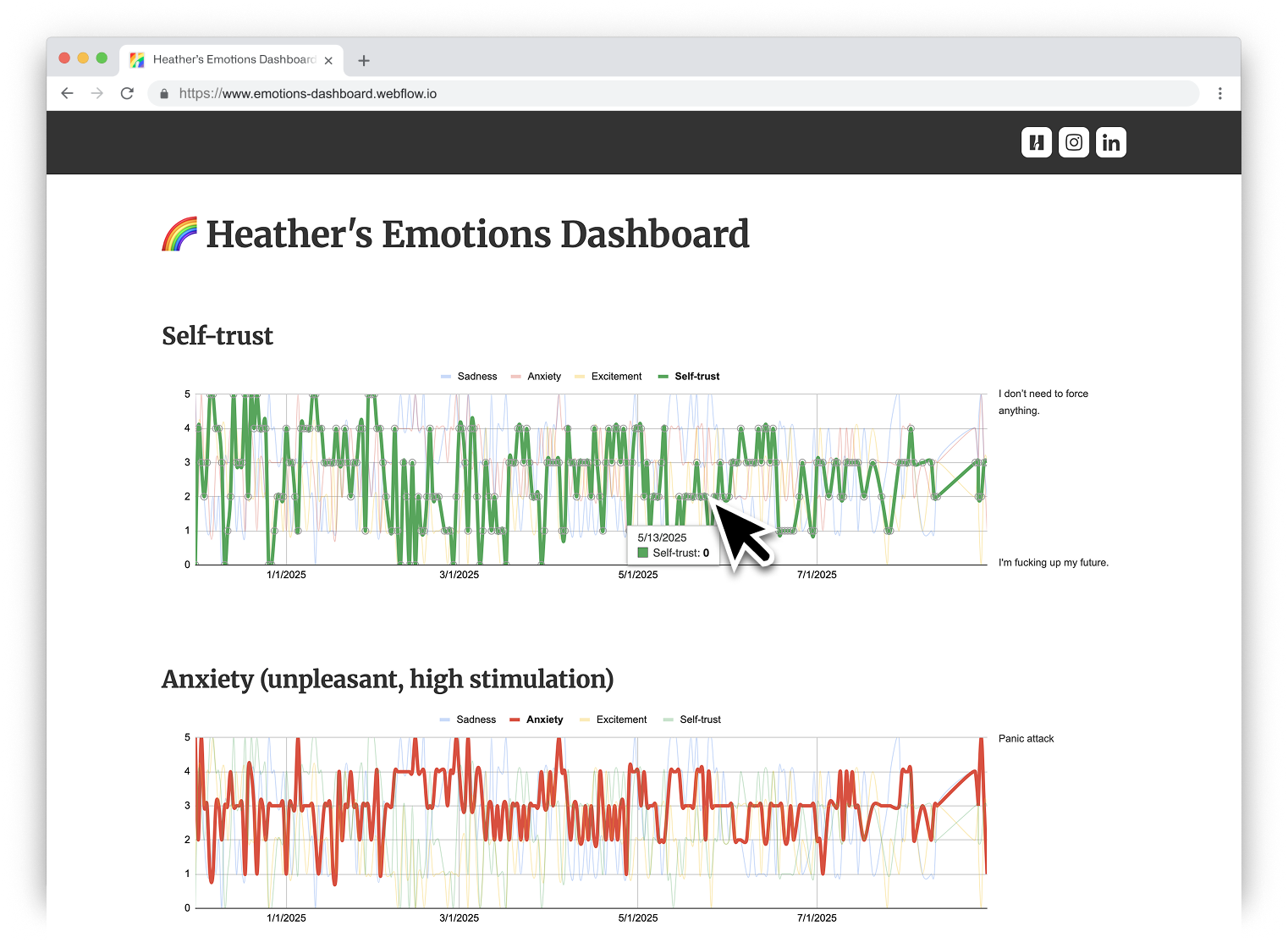
A year ago, I started logging my level of self-trust on a daily basis, in addition to 3 other core emotions.
Why?
I’ve always had big emotions, and have felt them deeply. I’m whatever the opposite of “avoidant” is. Even after years of therapy, medication, and hard work on myself… I still saw my big feelings (and hyperawareness of them) as a fundamental flaw.
I wanted to visualize “progress”, like I did in my Mario Kart experiment.
I also wanted an easy way to share how I was feeling to Keegan.
(And mayyybe impress him with my rookie web development skills, too 🤭)
Automating, simplifying, and optimizing the process
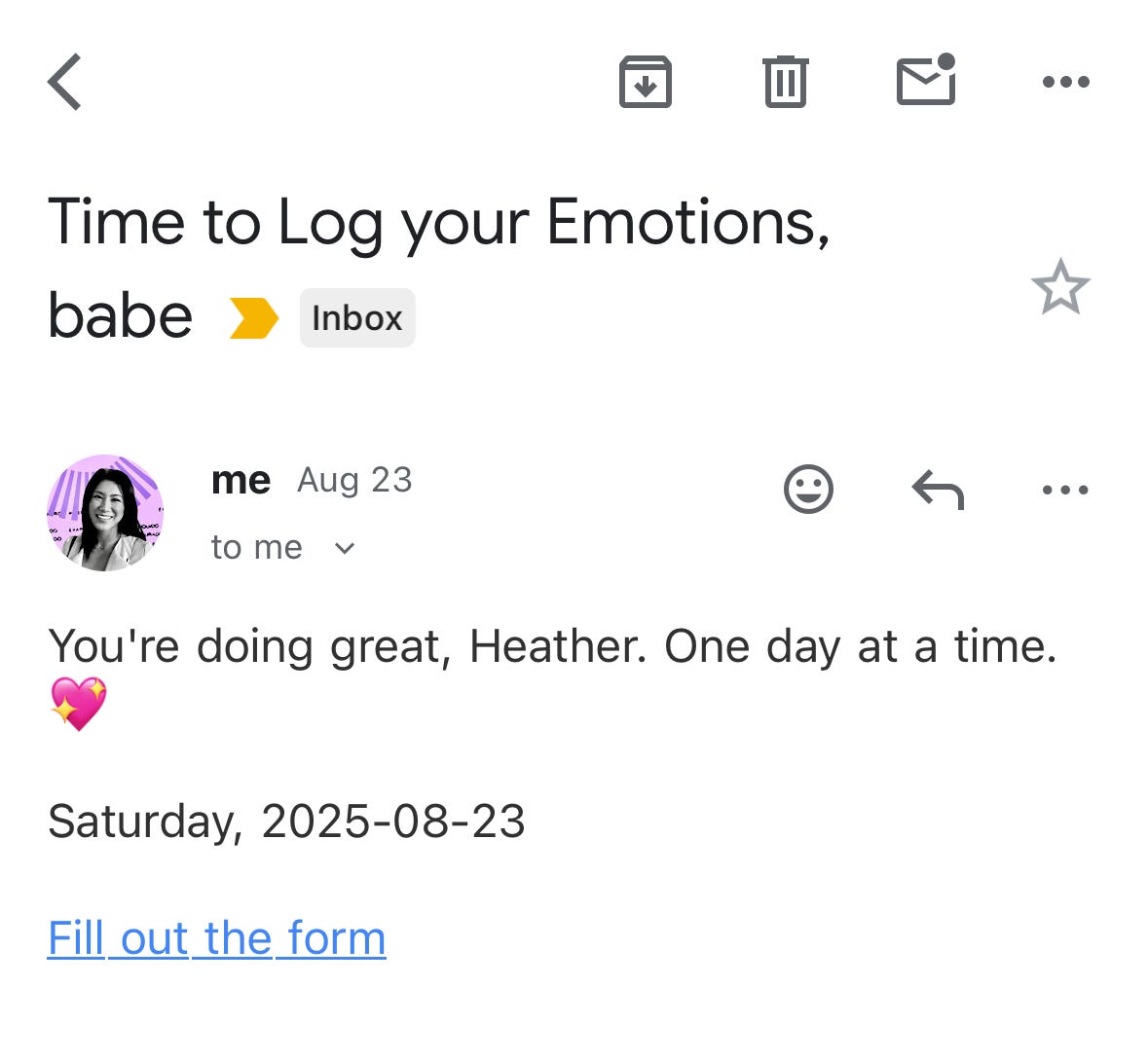
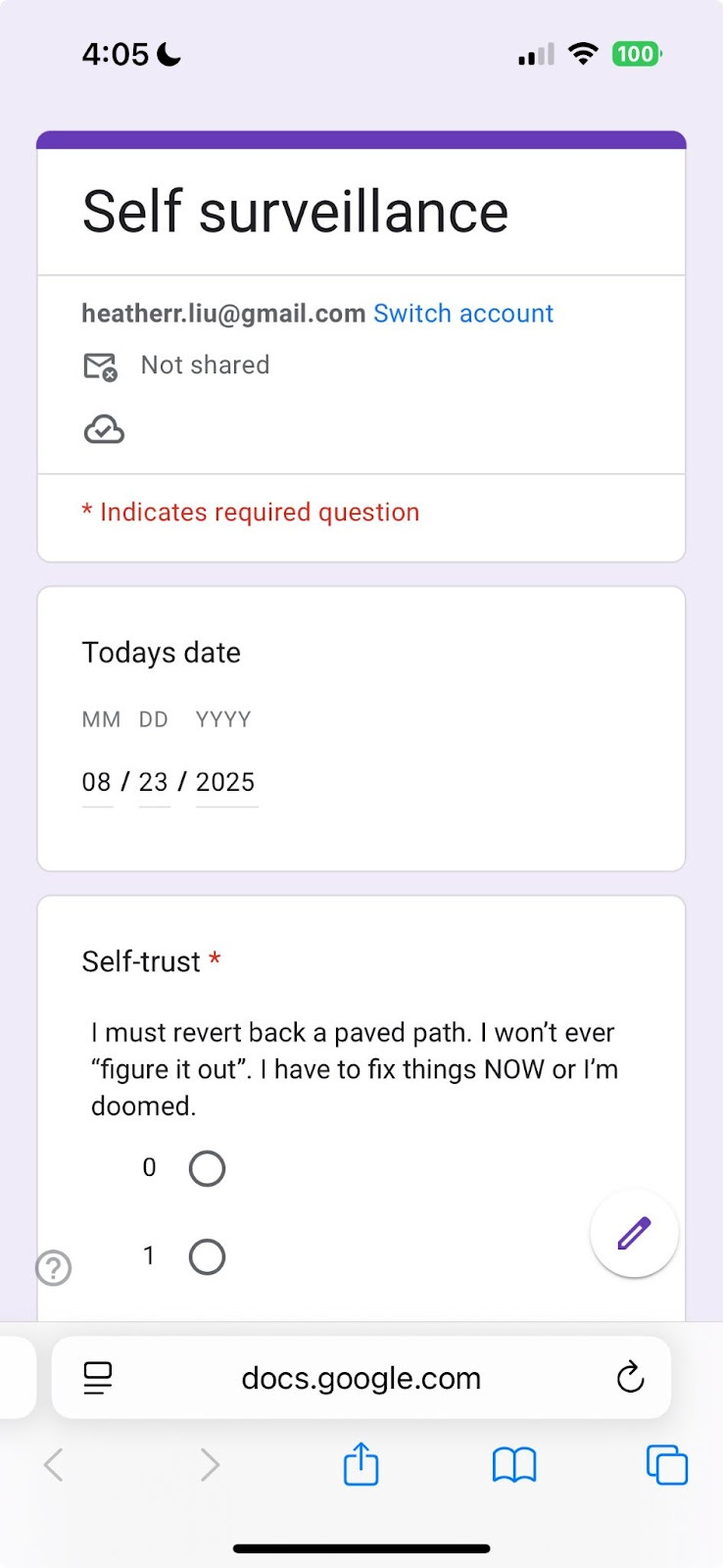
I used Apps Script to automate a nightly survey email arriving between 9-10 PM with a prefilled date, asking me to rate four emotions on a 0-5 intensity scale.

I defined the emotions as:
- Excitement (pleasant, high stimulation)
- 5 = ecstatic
- Anxiety (unpleasant, high stimulation)
- 5 = panic attack
- Sadness (unpleasant, low stimulation)
- 5 = utter hopelessness and despair
- Self-trust
- 0 = I’m fucking up my future
- 5 = I don’t need to force anything
I used self-trust in place of a “pleasant, low stimulation” feeling (aka calm), because I thought that was already reflected inversely in the anxiety axis. As a formally-trained modeler, following the principles of parsimony are of utmost importance 🫡
Mathematically, we’d call this exhausting the parameter space with orthogonal variables.
If you’re a management consultant, we’d call this MECE.
Survey responses automatically populate a web-based dashboard I built in Webflow (free plan!). I embedded iframes from the Google Sheets database and wrapped them in a simple UI.
Behold, the live dashboard.
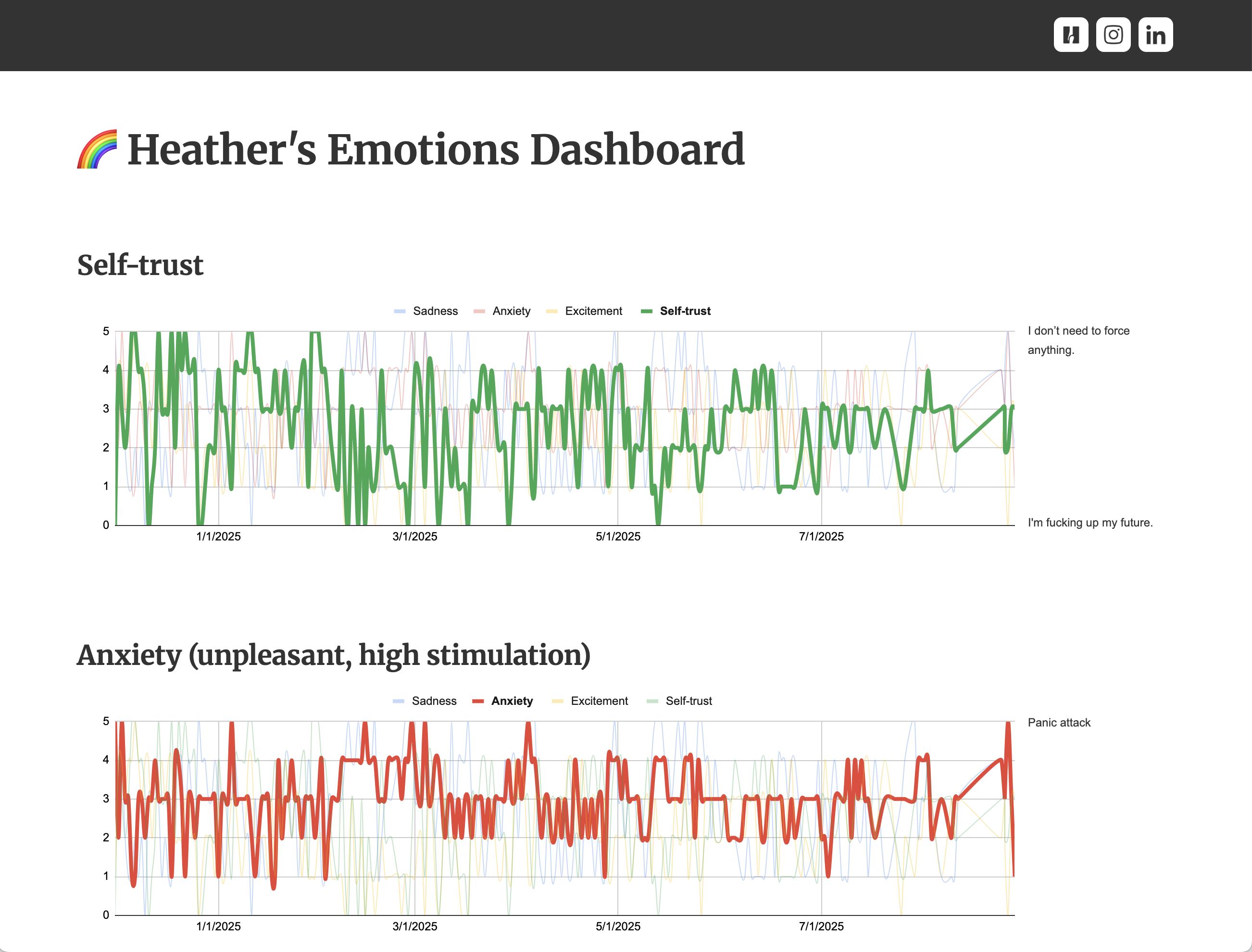
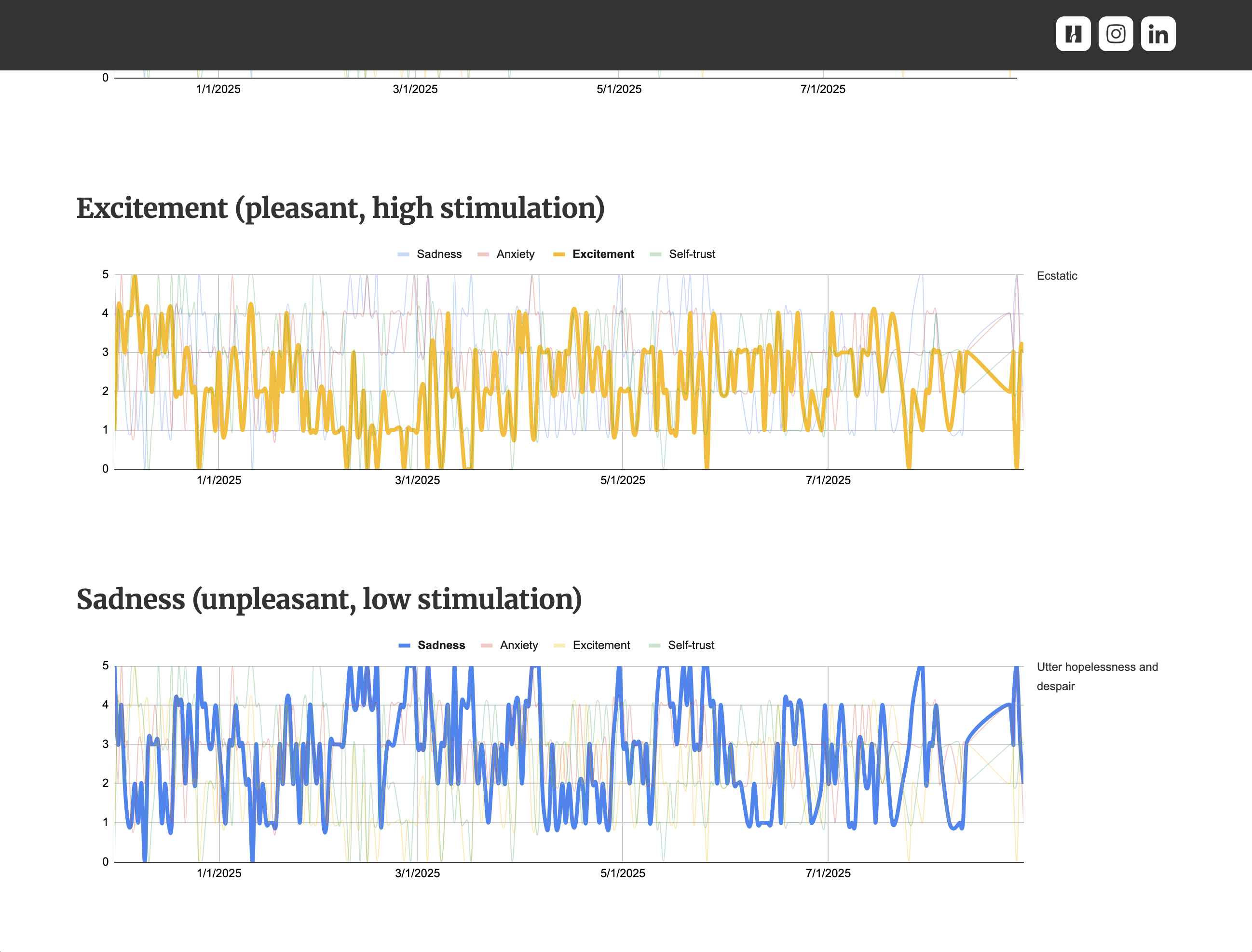
So…not much of a pattern. Just ups and downs without a meaningful trend.
Why the heck am I not making “progress”?!
At first, that's exactly what frustrated me. I wanted the lines trending upward like I was leveling up in a video game. For a while, that was discouraging because I was still thinking of some emotions as 'good' and others as 'bad.'
But then it clicked.
Emotions aren’t moral judgments. They’re not wins or losses.
They’re just information. Neutral signals about what matters to you.
Our emotions aren't problems to fix but signals to hear.
What started as a self-improvement project became a self-acceptance one.
The point wasn’t to feel better. It was to listen better.
And what I saw wasn’t failure. It was my own humanity.